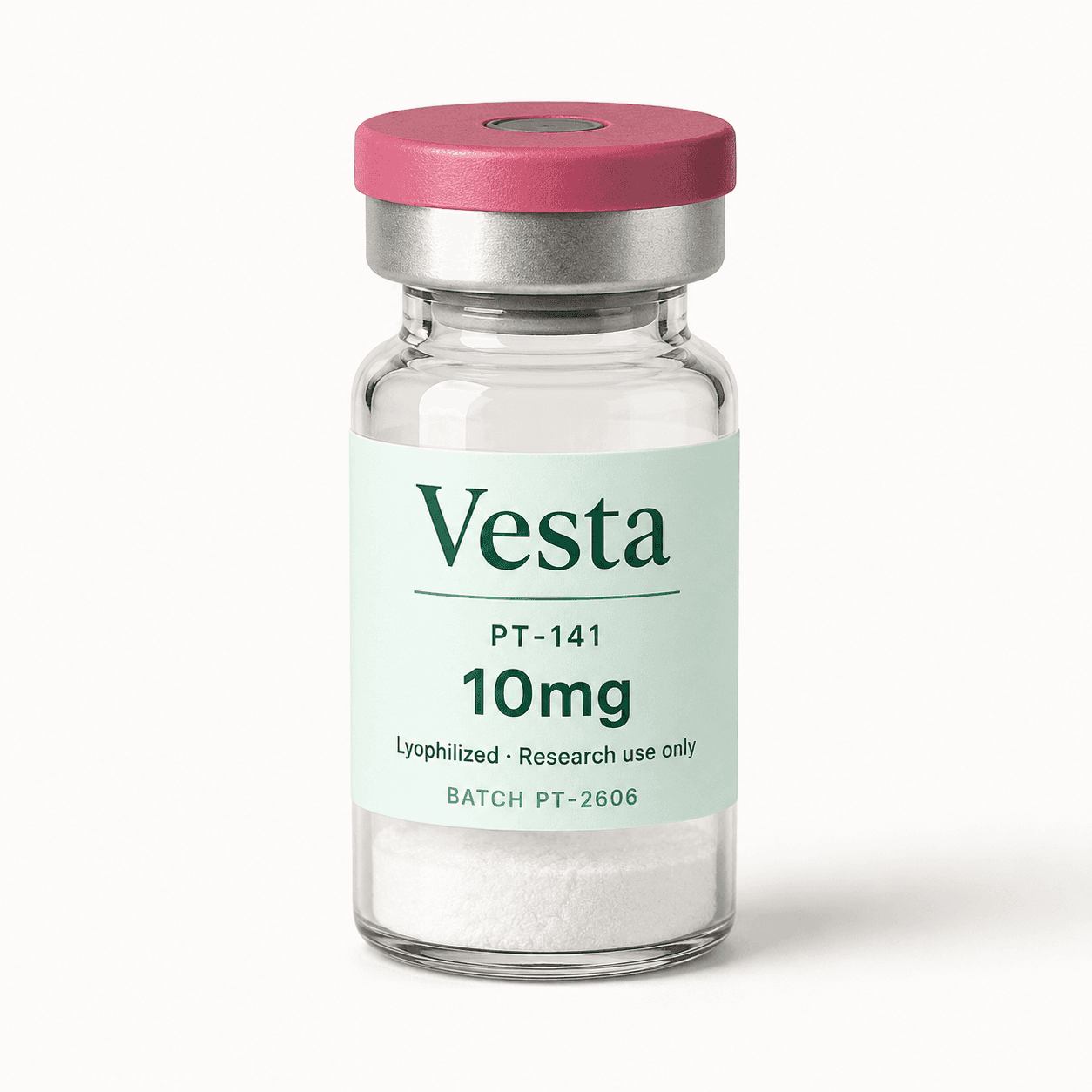
PT-141 (Bremelanotide) in Melanocortin Receptor Research
How PT-141 was derived from melanotan II, what receptors it targets, and what researchers should know about handling.
PT-141, also known by its non-proprietary name bremelanotide, is a synthetic melanocortin receptor agonist most studied for its effects on central sexual arousal pathways in animal and clinical models. It was originally developed as a more selective derivative of melanotan II, with the goal of preserving the central nervous system effects while reducing the peripheral pigmentation effects.
This article covers the melanocortin system briefly, PT-141's receptor selectivity profile compared to melanotan II, and standard research handling.
The melanocortin system
The melanocortin family of G-protein-coupled receptors has five members (MC1R through MC5R) with distinct tissue distributions and functions. MC1R is expressed on melanocytes and mediates pigmentation. MC2R is the ACTH receptor in the adrenal cortex. MC3R and MC4R are central nervous system receptors involved in energy balance, appetite, and sexual arousal pathways. MC5R has roles in exocrine gland function.
Synthetic melanocortin receptor agonists vary in their selectivity across the five receptors, which determines their primary effects. Research using these compounds requires careful attention to receptor profile — a non-selective agonist will activate multiple pathways simultaneously, confounding interpretation of central effects.
PT-141 vs melanotan II
Melanotan II is a cyclic heptapeptide that activates MC1R, MC3R, MC4R, and MC5R with relatively non-selective affinity. Its strongest research-documented effect is at MC1R (pigmentation), with central effects from MC3R and MC4R activation also present at higher doses.
PT-141 is a linear modified analog with substantially reduced MC1R affinity. It retains agonism at MC3R and primarily MC4R, which gives it a cleaner profile for studying central arousal pathways without confounding peripheral pigmentation effects. The shift in selectivity comes from removing the cyclization that contributes to melanotan II's MC1R binding and modifying side chains accordingly.
Pharmacokinetics in research models
PT-141's plasma half-life after subcutaneous administration is approximately 2 hours in reported animal pharmacokinetic studies — longer than melanotan II's roughly 30-minute half-life. This translates to a longer window of central effect per dose in research protocols, though it does not extend to the multi-day window of long-acting analogs in other peptide families.
Most published research designs use single-dose or short-course protocols rather than chronic administration, partly because of the receptor desensitization patterns observed with prolonged melanocortin signaling.
Reconstitution and handling
PT-141 is supplied as a lyophilized acetate salt. Standard reconstitution is at 2-5 mg/mL in sterile or bacteriostatic water. Refrigerate after reconstitution; the molecule is reasonably stable for several weeks at 2-8°C in bacteriostatic water based on published stability data.
Because acetate counterion content varies between manufacturers, researchers running protocols sensitive to effective peptide dose should use the peptide-content figure on the COA rather than gross mass. Vesta's COA reports peptide content alongside the HPLC and LC-MS data.
Vesta's QC for PT-141
Each PT-141 batch is HPLC-verified above 99.0% main-peak purity at 220 nm, mass-confirmed by LC-MS for the 1025.2 g/mol molecular weight, LAL-screened for endotoxin, and independently re-verified by a US-based third-party lab. The COA bundles the chromatogram, mass spec confirmation, and third-party verification into a single PDF.