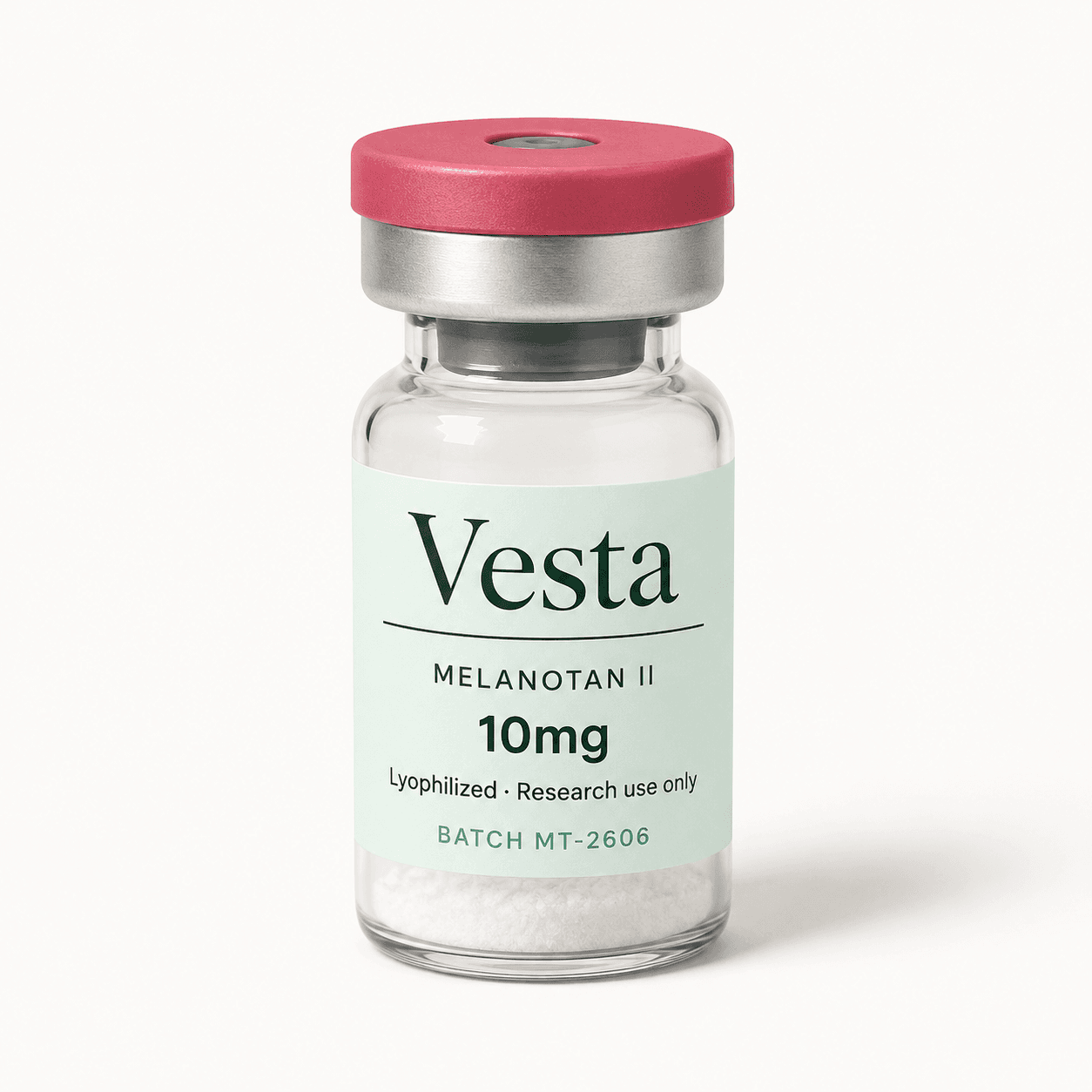
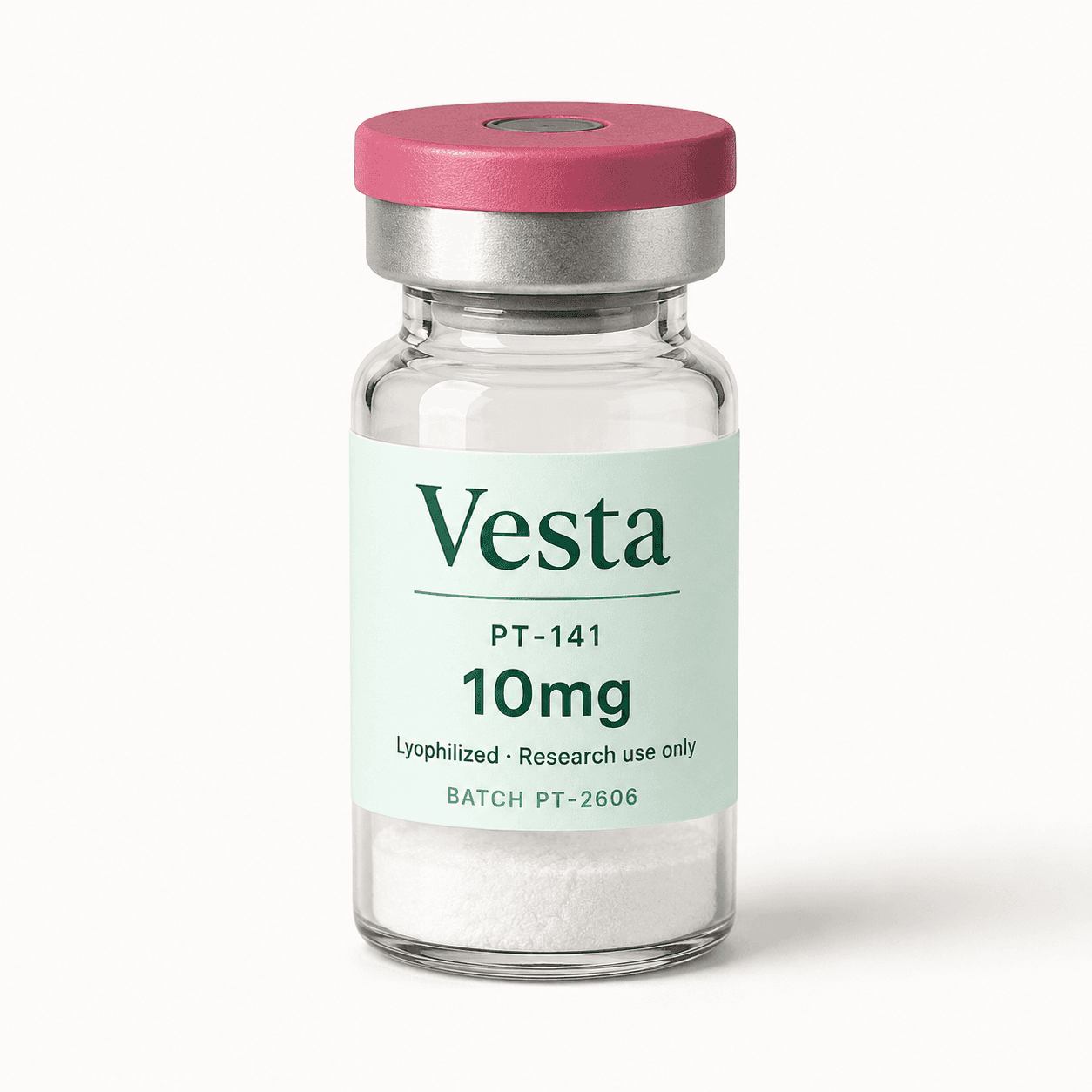
Melanotan II and the Melanocortin Receptor Family
The non-selective cyclic agonist that became the structural template for more targeted melanocortin research tools.
Melanotan II is a synthetic cyclic heptapeptide originally developed in the 1980s as a stabilized analog of α-melanocyte-stimulating hormone (α-MSH). It is non-selective across the melanocortin receptor family — it activates MC1R, MC3R, MC4R, and MC5R, each with distinct downstream effects. The non-selectivity is both its limitation as a research tool and the reason it has been useful as a structural template for more selective analogs like PT-141 (bremelanotide).
The five melanocortin receptors
MC1R is expressed on melanocytes and mediates pigmentation. Activation causes melanin production — the basis for melanotan II's pigmentation effects.
MC2R is the ACTH receptor in the adrenal cortex. Melanotan II does not have meaningful MC2R activity.
MC3R and MC4R are central nervous system receptors involved in energy balance, appetite regulation, and sexual arousal pathways. These are the targets of melanotan II's central effects.
MC5R is involved in exocrine gland function. Off-target activation here is generally well-tolerated in research models.
Pharmacokinetics
Melanotan II has a plasma half-life of approximately 30 minutes after subcutaneous administration. The molecule is cyclized between positions 4 and 10, which provides metabolic stability compared to linear α-MSH, but it still clears relatively quickly.
Most research protocols use small daily doses for pigmentation studies, or single-dose protocols for central effect studies. Chronic high-dose protocols are uncommon because of pigmentation accumulation and tolerance development.
Melanotan II vs PT-141 (bremelanotide)
PT-141 is a linear modified analog of melanotan II with substantially reduced MC1R affinity. The reduction in MC1R activity gives PT-141 a much cleaner profile for studying central arousal pathways without confounding peripheral pigmentation effects. Researchers studying MC3R/MC4R signaling specifically will usually prefer PT-141.
Researchers studying MC1R / pigmentation biology, or who want a broader-spectrum melanocortin agonist for non-specific pathway probing, will continue to use melanotan II. The two compounds are complementary tools rather than replacements.
Reconstitution and handling
Melanotan II is supplied as a lyophilized acetate salt. Reconstitution at 2-5 mg/mL in sterile or bacteriostatic water is standard. The reconstituted solution should be refrigerated and protected from light — the molecule is photosensitive.
Vesta's batch COA reports HPLC purity and acetate counterion content for accurate effective-dose calculation in protocols sensitive to peptide content.